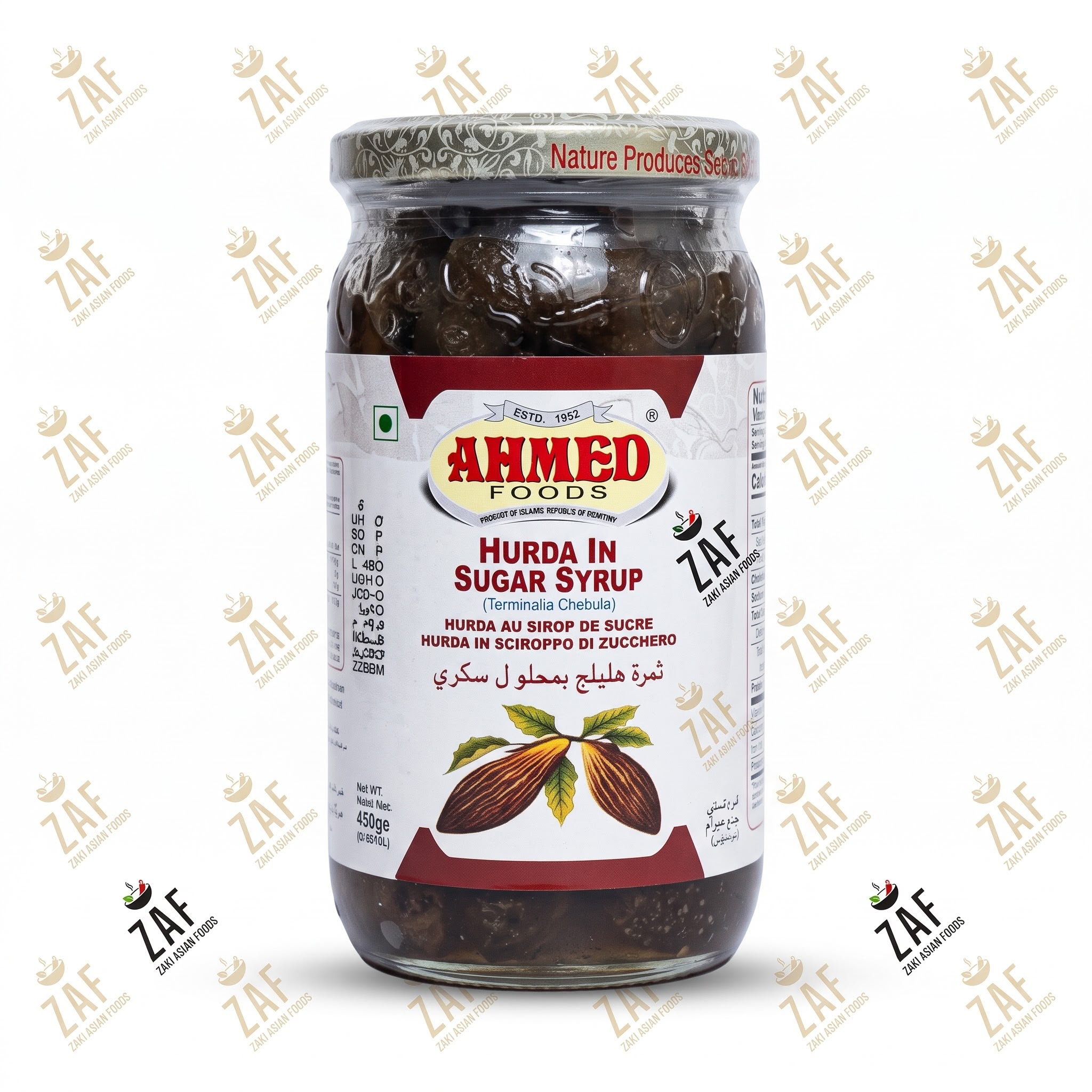
Discover the traditional taste of Ahmed Hurda in Sugar Syrup, a delicious South Asian fruit preserve made from Hurda (Terminalia Chebula), also known as Haritaki or Myrobalan, gently preserved in sweet sugar syrup.
Popular in traditional Pakistani and South Asian households, Hurda is valued for its distinctive fruity, slightly tangy and naturally astringent flavour. This traditional preserve combines the characteristic taste of Hurda with the sweetness of sugar syrup, creating a unique sweet treat that can be enjoyed on its own or alongside meals.
Ahmed Hurda Murabba is a convenient way to enjoy this traditional fruit preserve. It is suitable for people who appreciate authentic South Asian flavours and traditional preserved fruit products.
Manufactured by Ahmed Foods, a well-known Pakistani food brand, this product comes in a convenient 450 g pack.
Product Information
| Product Detail | Information |
|---|---|
| Product Name | Hurda in Sugar Syrup |
| Brand | Ahmed Foods |
| Product Type | Fruit Preserve / Murabba |
| Botanical Name | Terminalia Chebula |
| Common Names | Hurda, Haritaki, Myrobalan |
| Main Ingredients | Hurda and Sugar |
| Hurda Content | 48 g per 100 g of preserve |
| Total Sugar Content | 52 g per 100 g of preserve |
| Net Weight | 450 g |
| Serving Size | 50 g (2 tablespoons) |
| Servings Per Container | Approximately 9 |
| Flavour | Sweet with a distinctive fruity and tangy taste |
| Texture | Preserved fruit in sugar syrup |
| Country of Origin | Pakistan |
| Manufacturer | Ahmed Foods (Private) Limited |
| Packaging | Sealed retail food jar |
| Barcode | 545290506765 |
| Best Before | See date printed on packaging |
What Is Hurda (Terminalia Chebula)?
Hurda, scientifically known as Terminalia Chebula, is a traditional fruit used in South Asian food culture and traditional herbal systems, including Ayurveda and Unani.
It is also known as Haritaki or Myrobalan. The fruit is recognised for its distinctive taste and naturally occurring plant compounds, including tannins and polyphenols.
In Pakistan and other South Asian communities, Hurda is traditionally prepared as Murabba (fruit preserve) by preserving the fruit in sugar syrup.
Ahmed Hurda in Sugar Syrup offers this traditional preparation in a convenient ready-to-enjoy format.
Traditional Benefits and Nutritional Properties
Hurda is traditionally valued for its natural plant compounds and has been studied for its potential nutritional and biological properties.
| Nutritional / Traditional Property | Potential Benefits |
|---|---|
| Natural Plant Antioxidants | Hurda contains polyphenols and tannins that have antioxidant activity in laboratory research. |
| Traditional Digestive Use | Traditionally associated with digestive wellness in Ayurvedic and Unani practices. |
| Plant-Based Compounds | Contains naturally occurring tannins, phenolic acids and other plant compounds. |
| Traditional Herbal Value | Historically used in traditional herbal preparations. |
| Naturally Occurring Phytochemicals | Provides a variety of plant-derived compounds that are of interest in nutritional research. |
Possible Benefits of Hurda Fruit
1. Antioxidant Properties
Terminalia Chebula contains naturally occurring polyphenols and tannins. These compounds have demonstrated antioxidant activity in laboratory studies. Antioxidants help protect cells against oxidative damage.
2. Traditional Digestive Wellness
Hurda has a long history of use in traditional Ayurvedic and Unani practices for digestive wellness. However, this particular sugar-syrup preserve has not been established as a treatment for digestive problems.
3. Natural Plant Compounds
The fruit contains several naturally occurring compounds, including gallic acid, chebulagic acid and chebulinic acid, which have attracted scientific interest.
4. Traditional Wellness Ingredient
Hurda has been valued in traditional herbal systems for generations and remains an important fruit in South Asian food and cultural traditions.
Important Health Information: These properties relate to research and traditional knowledge about Terminalia Chebula. They do not establish that Ahmed Hurda in Sugar Syrup prevents or treats any disease. This preserve contains 52 g of sugar per 100 g, so it should be enjoyed in moderation as part of a balanced diet.
Nutritional Information
Serving Size: 50 g (2 tablespoons)
Servings Per Container: Approximately 9
Nutrition Facts
| Nutrient | Per 100 g | Per 50 g Serving |
|---|---|---|
| Energy | 1004 kJ / 240 kcal | 502 kJ / 120 kcal |
| Total Fat | 0 g | 0 g |
| Saturated Fat | 0 g | 0 g |
| Carbohydrates | 60 g | 30 g |
| Total Sugars | 52 g | 26 g |
| Dietary Fibre | 2 g | 1 g |
| Protein | 0 g | 0 g |
| Sodium | 0 mg | 0 mg |
Values are based on the nutritional information supplied on the packaging. Per-serving figures are calculated from the per-100 g values and are approximate.
Nutritional Highlights
- No fat: The supplied nutritional information lists 0 g total fat.
- No saturated fat: Contains 0 g saturated fat according to the label.
- Fruit-based preserve: Contains 48% Hurda fruit.
- Energy source: Provides carbohydrates that supply energy.
- Plant-derived ingredients: Made with Hurda fruit and sugar.
Please note: This is a sweet fruit preserve, not a low-sugar health food. One 50 g serving contains approximately 26 g of sugar.
Ingredients
| Ingredient | Details |
|---|---|
| Hurda (Terminalia Chebula) | 48% |
| Sugar | 52% of the preserve’s total sugar content, as declared on the packaging |
Total Sugar Content: 52 g per 100 g of preserve.
Allergen Information: The supplied ingredient declaration lists Hurda and sugar. No specific allergens are declared in the supplied information. Please check the physical packaging for any additional allergen or cross-contamination statements.
How to Enjoy Ahmed Hurda in Sugar Syrup
Ahmed Hurda Murabba can be enjoyed in different ways:
- Enjoy Directly: Eat a small portion straight from the jar as a sweet fruit treat.
- With Breakfast: Serve alongside breakfast or as part of a traditional South Asian meal.
- After Meals: Enjoy a small portion as a traditional sweet preserve after lunch or dinner.
- With Tea: Pair with a cup of tea for a sweet and tangy snack.
- With Desserts: Use small pieces as a topping for yogurt or other desserts.
Taste and Texture
| Feature | Description |
|---|---|
| Taste | Sweet, fruity and slightly tangy |
| Texture | Soft preserved fruit in syrup |
| Aroma | Characteristic fruity aroma |
| Colour | Natural appearance of preserved Hurda |
| Serving Temperature | Chilled or at room temperature |
| Best Pairing | Tea, breakfast and traditional South Asian meals |
Storage Instructions
- Store in a cool and dry place.
- Keep away from direct sunlight and excessive heat.
- Once opened, keep refrigerated.
- Always use a clean and dry spoon when serving.
- Keep the jar properly closed after each use.
- Check the Best Before date printed on the packaging.
Manufacturer Information
Manufactured by:
Ahmed Foods (Private) Limited
D-112, S.I.T.E., Karachi – 75700
Pakistan
Telephone: +92-21-32563520–24
Email: info@ahmedfood.com.pk
Website: www.ahmedfood.com.pk
Customer Feedback: customercare@ahmedfood.com.pk
Country of Origin: Pakistan
Frequently Asked Questions
1. What is Ahmed Hurda in Sugar Syrup?
It is a traditional South Asian fruit preserve made from Hurda (Terminalia Chebula) and sugar syrup.
2. What is Hurda also called?
Hurda is also known as Haritaki or Myrobalan.
3. Is Ahmed Hurda ready to eat?
Yes. It is a ready-to-eat fruit preserve. No additional preparation is required.
4. What are the main ingredients?
The declared ingredients are Hurda and sugar.
5. How much Hurda does the product contain?
It contains 48 g of Hurda per 100 g of preserve.
6. How much sugar does it contain?
The total sugar content is 52 g per 100 g. A 50 g serving contains approximately 26 g of sugar.
7. How should it be stored after opening?
After opening, keep the jar refrigerated and properly closed.
8. Where is Ahmed Hurda manufactured?
It is a product of Pakistan, manufactured by Ahmed Foods (Private) Limited in Karachi.
Product Summary
Ahmed Hurda in Sugar Syrup by Ahmed Foods is a traditional Pakistani fruit preserve made from Terminalia Chebula (Hurda) and sugar. With its distinctive sweet and tangy taste, it is perfect for enjoying as a traditional treat, alongside breakfast, with tea or after meals.